The post Rotary Kiln Predictive Maintenance to Prevent Downtime appeared first on Jammbco.
]]>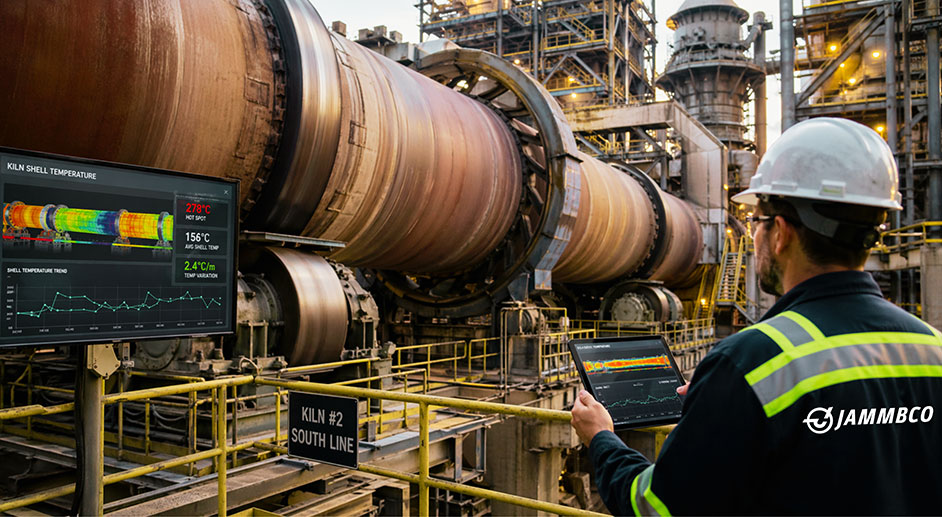
Rotary kiln downtime is rarely caused by a single dramatic failure. In most plants, it begins as a weak signal that is missed, dismissed, or disconnected from a decision. A hot bearing trend that is not tied to tyre creep. A shell temperature change that is treated as an isolated event. A chain area dust problem that is handled as housekeeping instead of a heat transfer issue.
For lime kilns in pulp and paper mills, and for cement kilns in clinker production, that gap between signal and action is expensive. It drives unstable operation, repeated stoppages, short refractory campaigns, high fuel use, dust recycle, ring formation, and restart risk. When teams rely only on calendar-based inspections or outage-only observations, they often find damage after performance has already been lost.
Rotary kiln predictive maintenance is the discipline of detecting those developing problems early enough to plan the response. In practical terms, it means combining process data, mechanical condition data, thermal data, and field observations so the plant can act before the kiln becomes the bottleneck.
For lime kiln superintendents, area superintendents, process engineers, mechanical engineers, maintenance managers, mill managers, and operations managers, the value is straightforward. Predictive maintenance turns kiln reliability from a shutdown problem into an operating practice.
Book a Kiln Performance Review if your plant is seeing rising fuel use, unstable shell temperatures, repeated build-up, or unexplained downtime risk.
Book a Kiln Performance ReviewWhat predictive maintenance means on a rotary kiln.
Predictive maintenance is not just installing sensors. It is a structured way to answer three questions.
- What is changing?
- Why is it changing?
- What action should be taken before the next operating or outage window closes?
On a rotary kiln, those answers have to cover both process and mechanical behavior. That matters because kiln failures are rarely confined to one discipline. Refractory distress changes shell temperature. Shell temperature changes mechanical loads. Mechanical distortion changes tire and roller contact. Poor contact changes vibration, power draw, and wear. Process instability then amplifies the problem through dusting, ring growth, coating loss, or poor heat transfer.
This is why rotary kilns punish siloed maintenance. A condition monitoring program that watches only bearings, or only the shell, or only the burner, will miss the interaction that causes downtime.
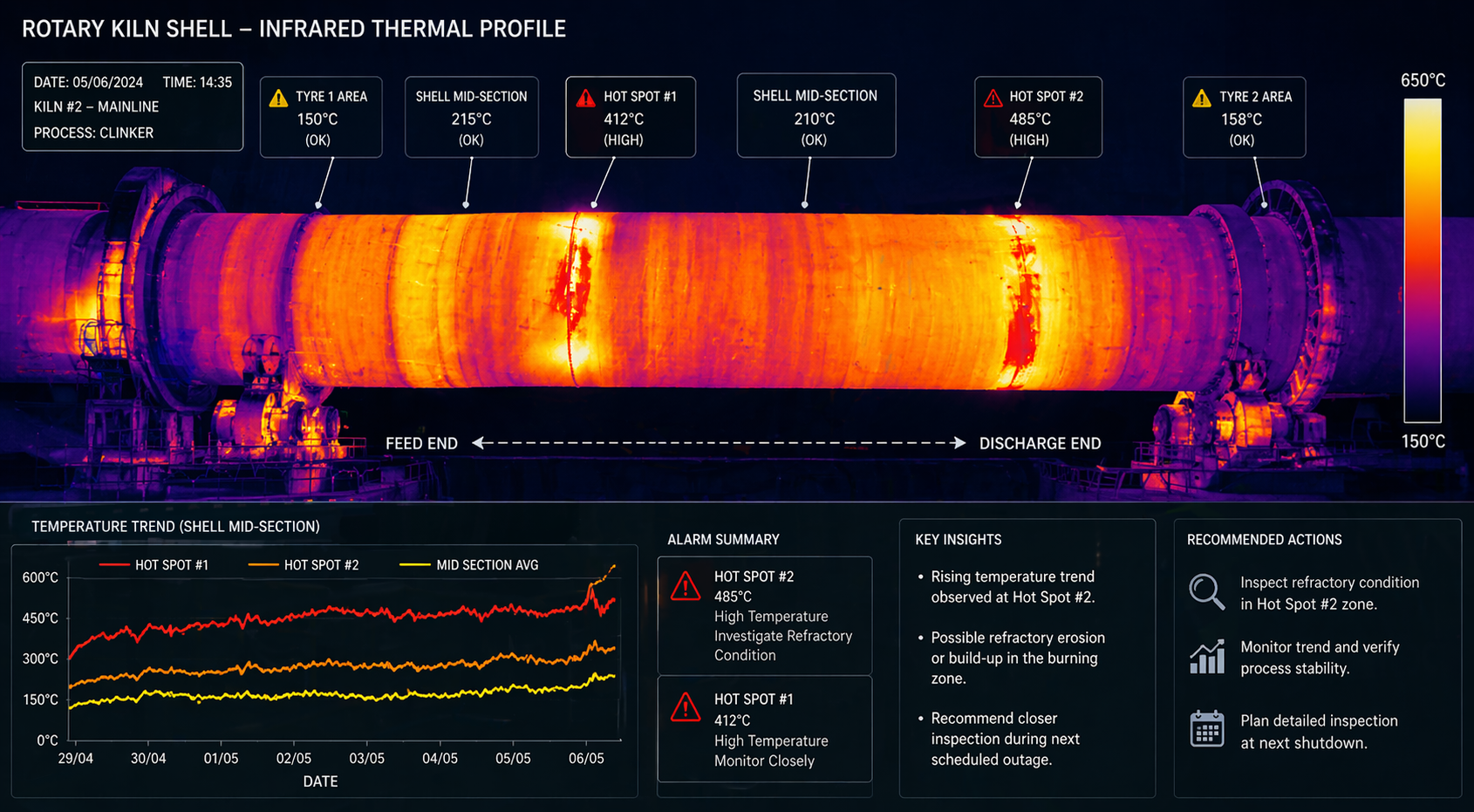
A thermal image of the kiln shell with highlighted hot spots and trend annotations.
A kiln outage is not only lost production hours. It often includes energy losses during cooldown and heat-up, damage to adjacent equipment, missed shipment targets, unplanned labour, and commercial pressure to restart before the root cause has been fully addressed.
In pulp and paper mills, lime kiln downtime can quickly push the recausticizing cycle into a capacity or chemistry constraint. In cement plants, kiln downtime can disrupt clinker inventory, burner tuning, refractory campaign plans, cooler performance, and downstream grinding schedules.
The operational cost comes from four compounding effects:
- Thermal Losses: Restarting a kiln consumes time and energy before stable operation is restored.
- Mechanical Escalation: Minor defects often damage neighbouring components when operation continues too long.
- Shutdown Compression: Work that should have been planned becomes urgent, crowded, and higher risk.
- Restart Instability: A kiln restarted without fully addressing the cause often returns with the same symptoms.
Which failure modes predictive maintenance should catch first.
The first goal is not to monitor everything equally. It is to monitor the failure modes that most often create forced outages, repeated slowdowns, or hidden performance loss.
Mechanical failure modes.
Mechanical problems usually develop gradually, but they accelerate when heat and load patterns change.
- Tyre and Roller Contact Problems. Poor contact patterns increase localized stress, wear, thrust behavior, and bearing temperature.
- Alignment Drift. Kiln axis movement, shell run-out, and support geometry changes can create abnormal load distribution and drive instability.
- Shell Ovality And Flexing. Excessive ovality reduces refractory life and increases risk around tyre stations.
- Drive Train Distress. Gear, pinion, gearbox, coupling, and motor issues often show up first as vibration, noise, temperature rise, or load variation.
- Lubrication Deficiencies. Heat, contamination, and inadequate application degrade bearings, gear sets, and riding ring interfaces.
Process and material failure modes.
Process problems are just as important because they often cause or intensify mechanical damage.
- Refractory Wear Or Brick Loss. A changing shell temperature profile may indicate thinning refractory, unstable coating, or a developing hot spot.
- Ring Formation And Build-up. Build-up changes gas flow, material movement, heat transfer, and local load conditions.
- Dust Recycle And Dusting. Excessive dust recycling reduces thermal efficiency and can destabilize the chain area or downstream equipment.
- Poor Heat Recovery. High exit gas temperature often signals lost recovery opportunity, drying problems, or ineffective chain performance in lime kilns.
- Burner And Combustion Instability. Unstable flame behavior can shift heat profiles and increase refractory, shell, and product quality risk.
Early indicators that matter most.
The most useful predictive maintenance signals are not always the most sophisticated. The best indicators are the ones that change early, can be trended consistently, and lead to a clear maintenance decision.
| Failure Mode | Early Indicator | Typical Source | Why It Matters |
|---|---|---|---|
| Refractory distress | Changing shell temperature profile | Infrared scanner, thermography, operator rounds | Helps identify hot spots, coating loss, and brick deterioration before severe shell damage. |
| Alignment or load distribution issue | Thrust movement, uneven tyre and roller contact, bearing temperature | Mechanical inspection, thermal checks, vibration | Indicates mechanical stress that can shorten refractory and component life. |
| Drive train problem | Vibration trend, gear temperature, abnormal sound, power fluctuation | Vibration monitoring, operator observation, drive data | Detects developing gearbox, pinion, coupling, or bearing issues. |
| Dust recycle or chain area inefficiency | High exit gas temperature, dust loading, unstable back-end temperature | Process historian, field observation, audits | Signals lost heat recovery and increased ringing or plugging risk. |
| Build-up growth | Differential pressure shifts, temperature changes, shell signatures, visual confirmation during outages | Process data, shell thermography, shutdown inspection | Supports earlier intervention before throughput loss becomes a forced stop. |
| Lubrication deficiency | Rising bearing temperature, wear debris, abnormal consumption, inconsistent application | Lubrication routes, oil analysis, inspections | Prevents avoidable damage in bearings, gears, and tyre interfaces. |
Reactive, preventive, and predictive maintenance are not the same.
Plants often say they are doing predictive maintenance when they are really doing time-based preventive maintenance with a few condition checks added on top. The difference matters.
| Maintenance approach | Trigger | Strength | Limitation |
|---|---|---|---|
| Reactive | Failure occurs. | No inspection effort before failure. | Highest downtime risk, highest collateral damage risk. |
| Preventive | Time or calendar interval. | Good for routine lubrication and known wear tasks. | May replace too early, or miss damage developing between intervals. |
| Predictive | Condition change indicates increasing risk. | Best for planning response around actual equipment behavior. | Requires clean data, trend discipline, and clear decision rules. |
A strong kiln strategy uses all three, but on purpose. Reactive work should be minimized. Preventive work should cover routine essentials. Predictive work should guide the high-consequence decisions that affect campaign life, outage scope, and restart risk.
Plan Your Next Kiln Outage.
Send Us A Message
What data should a rotary kiln team trend every week.
A useful predictive maintenance program starts with a short list of trendable variables that operations and maintenance trust. For most lime and cement kilns, the weekly review should include the following.
- Shell Temperature Profile. Trend full-shell infrared data or, at minimum, comparable location checks.
- Tyre, Roller, And Bearing Temperatures. Look for deviation from normal patterns, not only alarm exceedance.
- Vibration On Drives And Critical Rotating Components. Watch directional change and rate of change.
- Motor Load And Power Consumption. Abnormal shifts can indicate process resistance or mechanical distress.
- Kiln Thrust And Contact Patterns. Record how the kiln is riding, not just where it is riding.
- Exit Gas Temperature. In many kilns, this is one of the clearest indicators of declining heat recovery.
- Pressure Drop And Draft Stability. Useful for identifying build-up, plugging, or combustion instability.
- Fuel Rate Versus Throughput. A widening gap often points to heat transfer or process inefficiency.
- Dust Loading And Recycle Observations. These symptoms often expose chain section or back-end performance problems early.
- Inspection Notes From Operators. Repeated field observations are often the first signal that the data later explains.
Why standards still matter.
Standards are useful when they improve decision quality, not when they become paperwork.
For rotary kilns, the most relevant condition monitoring standards are the ones that help teams structure data collection and interpretation. ISO 17359 provides a framework for setting up a machine condition monitoring program. In plain language, it helps define what should be measured, how often, and how the result should influence maintenance decisions. ISO 18434-1 does the same for infrared thermography. In practice, that matters because kiln shell temperature data is only valuable if the method, severity criteria, and reporting are consistent enough to compare over time.
A plant does not need to build a rigid standards project to benefit. It does need consistency. If shell scans, bearing checks, lubrication routes, and vibration reviews are not repeatable, the trend cannot be trusted.
How predictive maintenance changes day-to-day work for each stakeholder.
For kiln and area superintendents:
The priority is operating stability. Predictive maintenance helps them see whether a problem is temporary process noise or a trend that will affect campaign life.
They should ask:
- Is the kiln running differently, or is it just running harder.
- Are we losing thermal efficiency before we see a production loss?
- Can this issue wait for the next outage, or does it need an operating change now.
For process engineers:
The priority is heat transfer, gas flow, and material behavior. Predictive maintenance turns process deviations into maintenance questions.
They should ask:
- Is high fuel consumption caused by feed variability, burner performance, poor heat recovery, or chain area inefficiency.
- Is build-up changing gas velocity, temperature profile, or residence behavior.
- Are exit gas temperature and dust loading telling us that back-end performance has drifted.
For mechanical and reliability engineers:
The priority is fit, load, wear, and lifecycle risk. Predictive maintenance gives them earlier visibility into component distress.
They should ask:
- Are tire and roller contact patterns still acceptable?
- Is shell thermal behavior creating mechanical risk at support stations.
- Do we have enough evidence to scope the next outage correctly?
For maintenance and mill managers:
The priority is planning, labour efficiency, and budget discipline. Predictive maintenance improves shutdown quality by narrowing the uncertainty before the outage starts.
They should ask:
- Which tasks truly need outage time.
- Which spare parts should be committed now.
- What can be addressed through operating practice, and what needs engineered change.
What to evaluate before changing hardware, materials, or monitoring scope.
Predictive maintenance should lead to better engineering decisions, not just more inspections. Before changing internals, lining systems, mounting hardware, or maintenance methods, the plant should evaluate five practical issues.
- Temperature Exposure: Match metallurgy and lining choices to the real temperature profile, not just the nominal design case.
- Gas Velocity And Dust Loading: Back-end geometry and internals should support heat transfer without creating avoidable dust generation or plugging risk.
- Working Internal Diameter: Any lining or chain area change should be assessed for its impact on gas flow, residence behavior, and maintainability.
- Installation Method: A good design can fail early if the outage execution plan is rushed or mis-sequenced.
- Inspection Access And Trendability: If a system cannot be inspected consistently, the plant loses predictive value after installation.
Where Jammbco fits into a predictive maintenance strategy.
Jammbco’s role is strongest where kiln performance, internal hardware, and field diagnosis intersect.
For example, if predictive maintenance identifies high exit gas temperature, excessive dust recycle, repeated chain area build-up, or declining back-end efficiency, the issue may not be solved by inspection alone. The kiln may need a better-configured internal heat exchange system, upgraded lining approach, or more durable support hardware.
For example, Jammbco could support with:
- Kiln chain systems, for chain selection, chain arrangement, and heat transfer support.
- Econoliners, for chain area lining strategy, shell protection, reduced gas velocity, and internal diameter considerations.
- Services, for field analysis, technical operational support, training, and installation supervision.
- Resources, for technical references and supporting material.
A practical Jammbco-led approach is usually structured around four steps:
- Diagnose The Real Failure Mechanism: Separate the symptoms, such as dusting, fuel rise, hot spots, or instability, from the underlying cause.
- Translate Findings Into Hardware And Outage Scope: Define the chain layout, liner concept, hardware requirement, and installation sequence required.
- Align Operations And Maintenance: Confirm that the solution supports throughput, reliability, and shutdown reality at the same time.
- Support Installation And Follow-Up: Use field services and post-install review to verify that the kiln is actually trending in the right direction.
Decision-support checklist before the next outage.
- What is the dominant risk, refractory, mechanical, process, or a combination.
- Which trend changed first.
- What evidence supports the planned repair scope.
- Do the current internals still match the operating envelope of the kiln?
- Has dust loading or gas velocity changed enough to justify a chain area or lining review.
- Will the outage solve the cause, or only remove the symptom.
- Do operations, maintenance, and engineering agree on success criteria after restart.
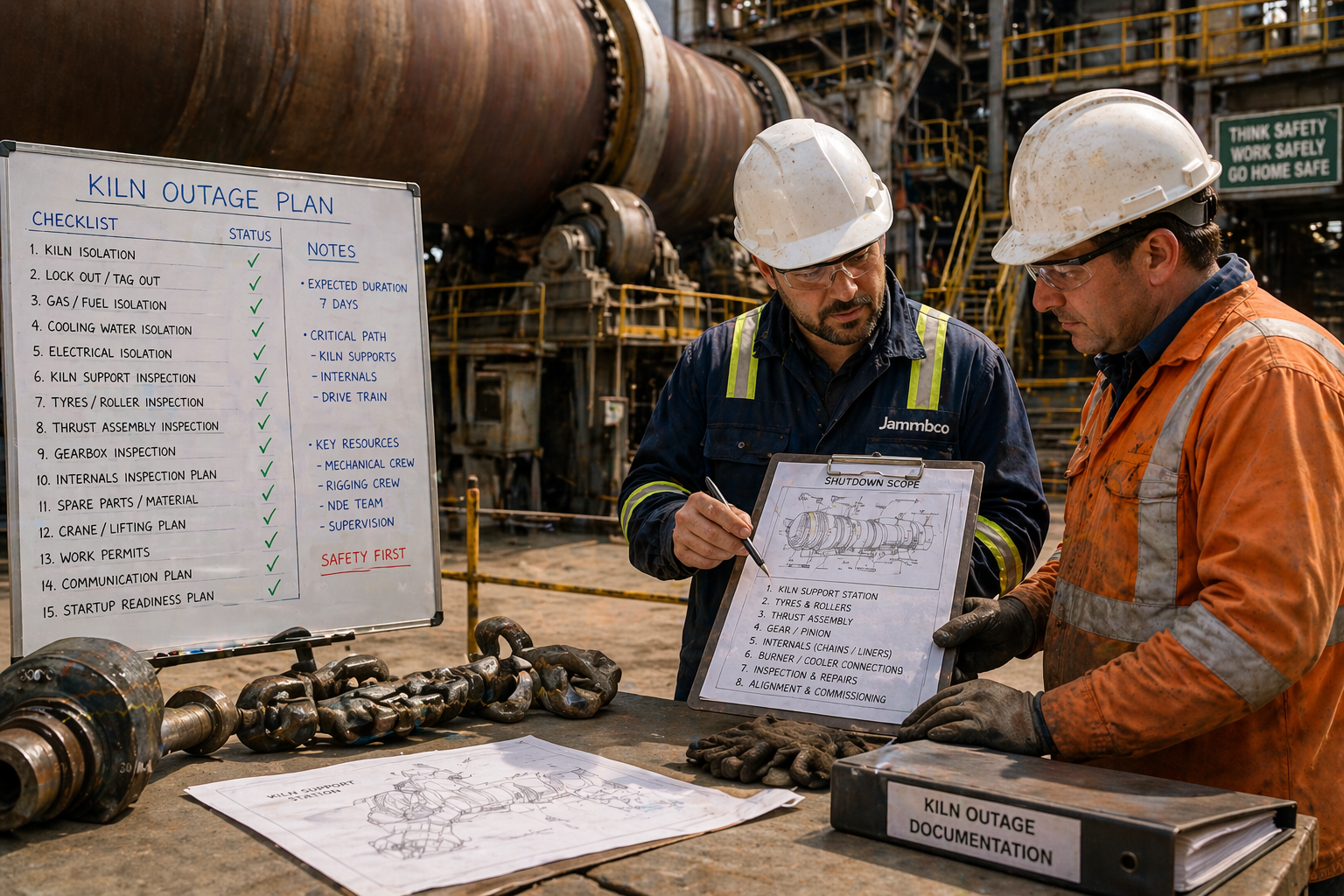
A field engineer and maintenance planner reviewing a shutdown scope near the kiln support station.
Before the next shutdown, make the decision window wider.
The best time to define outage scope is before the outage pressure starts. When operating data, thermal monitoring, and field inspection are reviewed together, plants can commit labour, parts, and engineering effort with far less guesswork.
Conclusion
Predictive maintenance on rotary kilns prevents costly downtime because it changes the timing of the plant’s decisions. Instead of waiting for a forced stop, the team can act when evidence first shows that the kiln is drifting away from stable operation.
That matters in both pulp and paper and cement because kiln losses rarely stay contained. Heat transfer problems become fuel problems. Fuel problems become build-up or stability problems. Mechanical drift becomes refractory stress. Refractory stress becomes downtime.
The best predictive maintenance programs are not complicated for the sake of being advanced. They are disciplined. They connect shell temperature, mechanical condition, process performance, and field observation into a repeatable decision routine. When that routine also informs hardware selection, shutdown planning, and installation execution, the kiln becomes easier to run, easier to maintain, and less likely to fail on the plant’s worst possible day.
Key takeaways:
- Predictive maintenance helps rotary kilns avoid costly downtime by identifying problems before they force an outage.
- The most useful warning signs are trend changes in shell temperature, vibration, tyre and roller behavior, bearing temperatures, exit gas temperature, and fuel use versus throughput.
- Kiln failures are rarely isolated, process instability, refractory distress, thermal imbalance, and mechanical wear usually interact and escalate together.
- Strong predictive maintenance combines operations, process, mechanical, and maintenance inputs, rather than relying on one department or one data source.
- In lime and cement kilns, predictive maintenance supports better heat transfer, lower fuel use, fewer build-ups, longer component life, and more reliable shutdown planning.
- The biggest practical benefit is better decision-making, teams can scope outages, prioritize repairs, and select hardware changes based on real kiln condition instead of guesswork.
Talk to a Kiln Specialist to discuss shell monitoring trends, chain area performance, build-up risk, or shutdown readiness.
Send Us A MessageFAQs (Frequently Asked Questions).
- What is predictive maintenance on a rotary kiln? Predictive maintenance on a rotary kiln is the practice of using condition and process trends to identify developing problems before they cause a forced outage. It typically combines shell temperature monitoring, vibration, bearing temperatures, process trends, inspection notes, and outage findings.
- Why is predictive maintenance better than time-based kiln maintenance? Time-based maintenance is useful for routine tasks, but it does not always match the actual condition of the kiln. Predictive maintenance helps the plant intervene when risk is increasing, not simply when the calendar says it is time.
- What are the first signs that a lime kiln needs predictive maintenance? Common early signs include high exit gas temperature, rising fuel consumption, repeated dust recycle, chain area build-up, unstable shell temperatures, and recurring mechanical adjustments between outages.
- What are the first signs that a cement kiln needs predictive maintenance? Look for unstable shell temperature patterns, changing coating behavior, build-up, unusual thrust movement, drive vibration, hot bearings, and throughput loss that cannot be explained by feed alone.
- How does shell temperature monitoring help prevent downtime? Shell temperature trends can reveal refractory thinning, brick loss, coating changes, and localized hot spots before severe damage occurs. The value comes from trending the profile consistently and acting on deviation, not just responding to alarms.
- Can predictive maintenance reduce fuel consumption in a lime kiln? Yes, when the root cause is tied to heat transfer or back-end inefficiency. Predictive maintenance helps the plant identify whether high fuel use is linked to dust recycle, poor chain performance, unstable drying, burner issues, or another operating constraint.
- What causes buildup in rotary kilns? Build-up is usually driven by a combination of chemistry, temperature profile, gas flow, dust behavior, and local surface conditions. In practice, that means it should be treated as a system problem, not just a cleaning problem.
- When should a kiln chain system be reviewed or replaced? A chain system should be reviewed when the kiln shows declining heat recovery, high exit gas temperature, repeated dusting, excessive chain area build-up, shortened chain life, or maintenance effort that no longer matches the value delivered.
- How do Econoliners support predictive maintenance? They help by making the chain area more stable and maintainable when the existing lining approach is limiting internal diameter, increasing dust, or exposing the shell to avoidable wear. They are most effective when selected as part of an engineered review, not as a standalone part swap.
- What data belongs in a weekly kiln reliability review? At minimum, include shell temperature trends, bearing and roller temperatures, vibration, motor load, thrust behavior, exit gas temperature, pressure profile, fuel rate versus throughput, and notes from field inspections.
- Does predictive maintenance replace kiln shutdown inspections? No. It makes shutdown inspections more valuable. Predictive maintenance narrows the scope, improves planning, and helps the team know what to confirm once the kiln is open.
- Who should own rotary kiln predictive maintenance? No single role can own it alone. The strongest programs are shared across operations, process engineering, mechanical reliability, and maintenance planning, with clear decision rules and one agreed review cadence.
Click here and download this article as a PDF.
Download PDFThe post Rotary Kiln Predictive Maintenance to Prevent Downtime appeared first on Jammbco.
]]>